


AI Vision Inventory Robot
Vision-Powered Autonomous Inventory Management
The AI Vision Inventory Robot is an autonomous mobile robot that counts stock using AI cameras and computer vision instead of RFID tags. It drives your aisles on its own, recognises products, books, labels and shelf locations in real time, validates what it sees on board, and syncs the result to a cloud platform — running 24/7 and completing a stock take up to 90% faster than counting by hand.
AI Vision Technology
Advanced AI cameras recognise products, boxes, labels and shelf locations with precision.
Autonomous & Smart
SLAM navigation, obstacle avoidance and autonomous charging for 24/7 operation.
Inventory Intelligence
Real-time data collection and analytics for accurate inventory and reports.
Cloud Connected
Secure cloud platform for remote monitoring, reporting and system management.
What is an AI vision inventory robot?
An AI vision inventory robot is an autonomous mobile robot that counts and verifies stock using cameras and computer vision, rather than by reading RFID tags or by a person walking the aisles with a scanner.
Traditional stocktaking has three problems that never go away: it is manual, it is slow, and it is inconsistent. Counts happen quarterly rather than continuously because each one costs a shift of labour, and by the time the numbers are compiled they are already out of date.
The AI Vision Inventory Robot removes the labour from the loop. It runs a scheduled task overnight or between shifts, recognises what is on each shelf, flags what is missing or misplaced, and has a report waiting before the floor opens.
The key difference is that it needs no RFID infrastructure. RFID stocktaking is fast and accurate, but only after every item carries a tag and the estate is maintained. For collections that are not tagged — or where tagging every item is not economic — that is a hard barrier to entry.
Computer vision reads what is already there: the product itself, the box, the printed label, the barcode and the shelf position. Nothing has to be applied to the stock before the robot can start counting it.
How the AI Vision Inventory Robot works
Every stock take runs the same six-step cycle, from a scheduled task to a finished report — with no person in the aisle at any point.
Mission setup
Set the stock take task, select the areas or scan groups to cover, and schedule when the robot should run.
AI scanning & recognition
The AI vision system scans the shelves and recognises items, barcodes and labels in real time as it travels.
Cloud sync in real time
Validated inventory data is uploaded instantly to the cloud platform, so results are available while the robot is still working.
Autonomous navigation
The robot navigates the environment on its own using SLAM, avoiding obstacles and optimising its path through the aisles.
Data validation
Captured data is validated on board the robot to ensure accuracy and completeness before anything is sent onward.
Reports & insights
It returns to a charging dock on its own when idle. The P300 charges 10–80% in under an hour; the P1500 swaps a battery in 30 seconds without powering down.
Capabilities
Eight capabilities that make unattended, repeatable stocktaking possible.
AI camera vision
Obstacle Avoidance
Real Time Inventory Intelligence

Automatic Charging

Autonomous Navigation
24/7 Operation

Cloud Analytics

Safe and Reliable
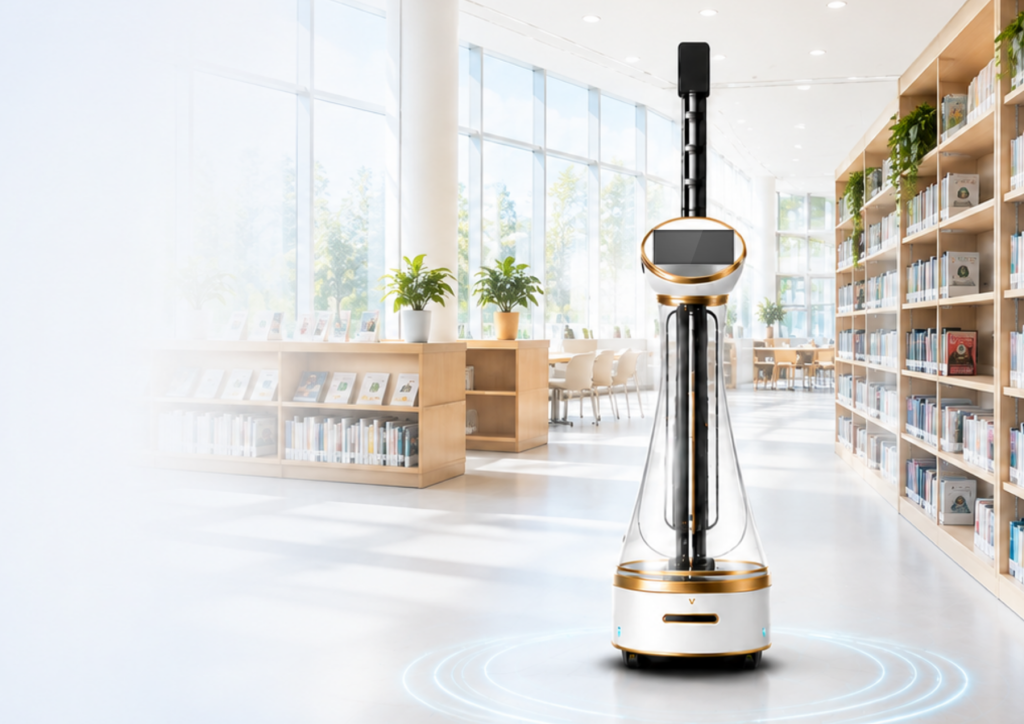
Designed for modern facilities
Anywhere stock sits on shelves, needs counting often, and is not economically taggable.
Libraries & archives
Shelf-reading and collection audits without closing the floor. The platform includes item locating by barcode and floor-plan search, plus misplaced-item detection — the two jobs that consume most shelving time.
Warehouse & distribution
Cycle counting across racking without pulling staff off picking, and item-level reports exported straight to Excel or an upstream system.
Education & institutions
Campus libraries, resource centres and equipment stores with large collections and small teams.
Retail & supermarket
Continuous shelf counts instead of quarterly ones, with missing and misplaced stock flagged before a customer finds the gap.
Manufacturing stores
Component and consumable stores where accuracy drives line availability, and where a missed part costs more than the count.
Asset-heavy facilities
Patrol management doubles the robot as a scheduled floor-check platform between inventory tasks.
Other AI robotics
Find out other AI robot solutions
_______
LIBRA Stock Take Robot
____
Humanoid
____
AI Robotic Arm
____
Quadruped Robot
____
Mini Automated Guided Vehicle
____
Autonomous Delivery Robot
Advanced navigation, obstacle avoidance, and intelligent route planning
______
Autonomous Cleaning Robot

Tell us the task, not the robot
Describe the work you want automated — what moves, how often, how far, and how many people it takes today. That is enough for HKC to say which robot fits, whether the numbers work, and what a pilot would involve.
