
Automated Delivery Robots for Factories and Warehouses
An automated delivery robot is a self-driving mobile robot that transports materials between fixed points inside a factory, warehouse or building — without rails, magnetic tape, floor markers or a driver. SEER Robotics builds two: the P300, a 300 kg cart-format robot for totes, racks and line-side supply, and the P1500, a 1,500 kg pallet-fork robot for heavy pallet moves. Both navigate by 3D laser SLAM, stop within ±10 mm of the target point, and can be commissioned in about 10 minutes.
Positioning accuracy
±10 mm position, ±0.5° heading
Setup time
about 10 minutes to first delivery task
Navigation
Laser SLAM free navigation — no tape, wire or reflectors required
Operation
7 × 24 with automatic recharging
What is an automated delivery robot?
An automated delivery robot is an autonomous mobile robot (AMR) that carries goods from one point to another inside a building, planning its own route and avoiding people and obstacles as it goes.
The category sits between two older technologies. A conveyor moves goods reliably but only along the path it was built on; changing it is an engineering project. A forklift or tugger goes anywhere but needs a trained operator for every trip.
An automated delivery robot keeps the flexibility of the second without the labour of the first. It receives a destination, works out its own path, and delivers. Change the destinations and the traffic pattern changes with them — usually as a configuration change rather than a construction project.
AMR versus AGV. A traditional AGV (automated guided vehicle) follows a fixed guide path — magnetic tape, an embedded wire, or a painted line. It cannot deviate. An AMR builds a map of the building and localises against it, so it can route around a pallet left in the aisle instead of stopping in front of it.
The SEER P Series robots are AMRs. They use laser SLAM against the building’s own structure, so no tape, wire, reflectors or floor markers have to be installed before they run.
How does an automated delivery robot work?
Every delivery is the same four-step cycle: receive a task, plan a route, travel while avoiding obstacles, and hand the load off at the destination.
Receive the task
An operator taps a destination on the robot's screen, sends it from a phone, or an upstream system (WMS, MES, ERP) issues it over the API. A call terminal at the pick-up point works too.
Travel and avoid
A head-mounted 3D lidar and obstacle camera scan 360° horizontally with a tall vertical field; two 2D safety lidars cover the chassis front and rear. The robot slows, routes around, or stops.
Pass through the building
Where a route crosses floors or fire doors, the robot calls the lift and opens the door itself over the IoT integration — elevators, doors, gates and access control.
Autonomous navigation
The robot locates itself on its stored map using 3D laser SLAM, then plans a route. Maps of up to 400,000 m² are supported in a single map, so one map can cover a whole site.
Arrive and hand off
It stops within ±10 mm and ±0.5° of the target point and releases the load — jacking down a rack, lowering forks, running a conveyor top, or simply waiting to be unloaded.
Recharge and repeat
It returns to a charging dock on its own when idle. The P300 charges 10–80% in under an hour; the P1500 swaps a battery in 30 seconds without powering down.
Where automated delivery robots are used
The economics work wherever the same move is repeated many times a day over a fixed distance — which is most of what happens on a factory or warehouse floor.
Line-side supply
Feeding parts, kits and consumables to assembly stations on a fixed cadence, and clearing finished work away. Scheduled and looping tasks match the line's own rhythm.
Dock to warehouse
Moving inbound pallets from the receiving dock into the racking area, and staging outbound pallets for loading — the P1500's core job.
Point-to-point delivery
The simplest deployment: one robot, one route, a screen tap to dispatch. Often the pilot that proves the case before a fleet is bought.
Warehouse to production line
Long cross-site runs between storage and manufacturing. A single map covers up to 400,000 m², so the route does not have to be broken into segments.
Inter-zone transfer
Connecting areas that are close together but separated by doors, lifts or fire barriers. The robot opens and calls them itself.
Multi-floor buildings
Elevator integration lets a route cross floors unattended, which matters in retrofitted buildings never designed around material handling.
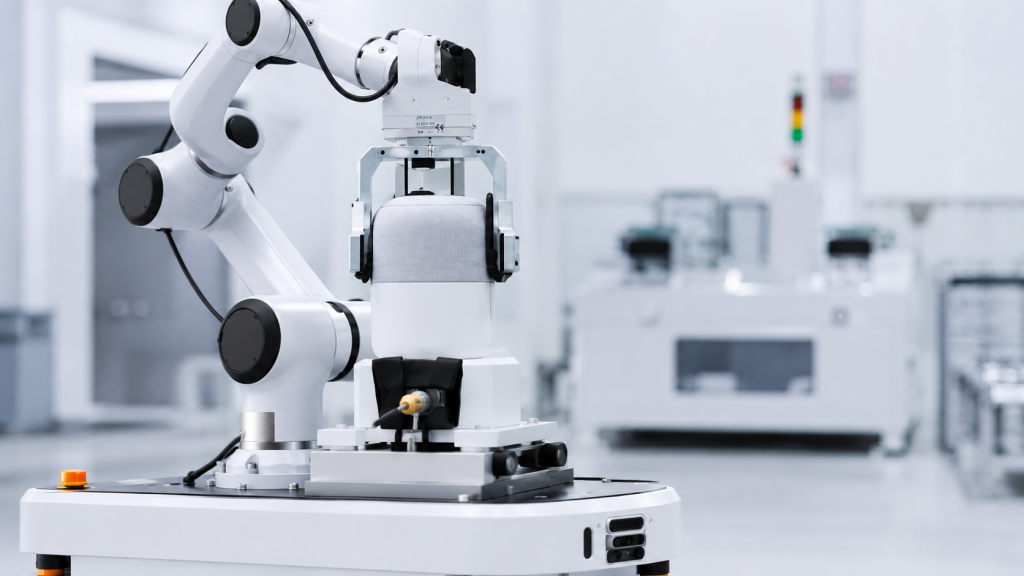
Other AI robotics
Find out other AI robot solutions
_______
LIBRA Stock Take Robot
____
Humanoid
____
AI Robotic Arm
____
Quadruped Robot
____
Mini Automated Guided Vehicle
_______
AI Vision Stock Take Robot
AI image processing algorithm automatically scans for efficient inventory management
______
Autonomous Cleaning Robot

Tell us the task, not the robot
Describe the work you want automated — what moves, how often, how far, and how many people it takes today. That is enough for HKC to say which robot fits, whether the numbers work, and what a pilot would involve.