
Smart Healthcare
Smart healthcare connects call systems, sensors, health monitoring and real-time location tracking so that clinical and care staff know immediately when a patient or resident needs help — and can prove how quickly they responded. HKC supplies the full stack for hospitals, nursing homes and residential care facilities: nurse call units, bed and seat pad sensors, panic wristbands, washroom fall detection, vital sign monitors, Bluetooth indoor positioning and EHR-linked care signage — all reporting into one cloud alarm monitoring platform.
one platform
EVERY ALARM IN A SINGLE CONSOLE
Real-time
LOCATION TRACKING ON THE FLOOR PLAN
What is Smart Healthcare?
Smart healthcare is a hospital, nursing home or care facility where calls, falls, vital signs and patient location are detected and recorded automatically, instead of depending on someone noticing.
Keeping a care facility safe and secure is a genuinely complex task. There are more patients to serve, tightening regulations, and real security challenges — and the staff doing the work are stretched across wards, floors and shifts.
The gap is rarely willingness. It is visibility: someone who falls in a washroom, slips out of bed at night, or wanders off a floor is only found when a member of staff happens to look.
Connecting the building closes that gap. A pulled cord, a pressed wristband, an empty bed sensor or ten minutes of no movement in a toilet cubicle all raise the same thing: an alarm, with a location, in one monitoring console.
That changes two things at once — patients are reached faster, and the facility has a defensible record of how long it took.
How it works
From a pressed button to the right carer
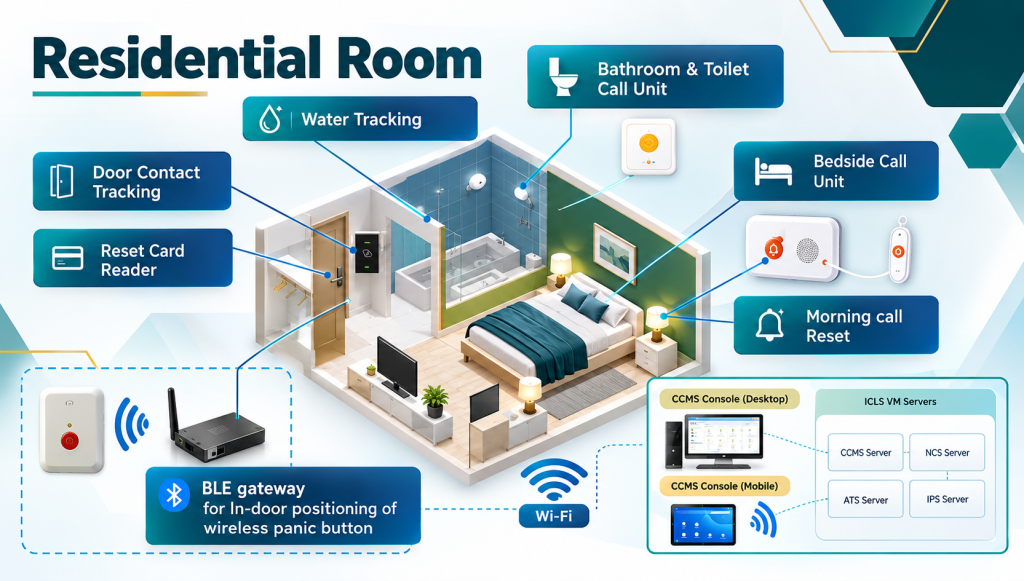
Every device in a resident’s room follows the same four steps — and the loop only closes when a member of staff arrives.
In the room
Something happens
- Bedside call unit
- Bathroom & toilet call unit
- Wireless panic button
- Bed / seat pad sensor
- Washroom fall detection
- Morning call reset
- Door contact sensor
- Water usage tracking
A button is pressed — or nothing happens when it should.
Out of the room
The event is carried
- BLE gateway — adds the location
- Wi-Fi network — carries the event
This is the step that turns “help” into “help, in room 312”.
Four services
The system works it out
- CCMS Logs it and places it on the floor plan
- NCS Runs the call units and two-way speech
- IPS Turns gateway readings into a position
- ATS Routes the alert to the right devices
All four run on one virtual platform — one server host, not four boxes.
Staff respond
It reaches a person
- Desktop console in the control office
- Mobile console for carers on the floor
The alarm arrives with the resident, the room, the device and the time elapsed.
And the loop closes
The carer attends and taps the reset card reader in the room. That clears the alarm — and records who attended and how long they took. Response time is measured automatically, rather than reported.
Five pillars of care technology
HKC builds smart healthcare deployments around the five areas where technology measurably improves patients’ and residents’ lives.
_______
Call Units
_______
Fall Detection
____
Signage
____
Wireless Bed / Seat pad sensor
Wireless Bed / Seat pad sensor
A pressure pad that detects when a resident leaves a bed or chair unassisted.
____
Real-time Location System Cloud Solution Platform
Real-time Location System Cloud Solution Platform
Real-time centralized monitor and manage all health and information alerts
______
Precise Positioning System
____
Vital Sign Monitoring
Deployed and Running
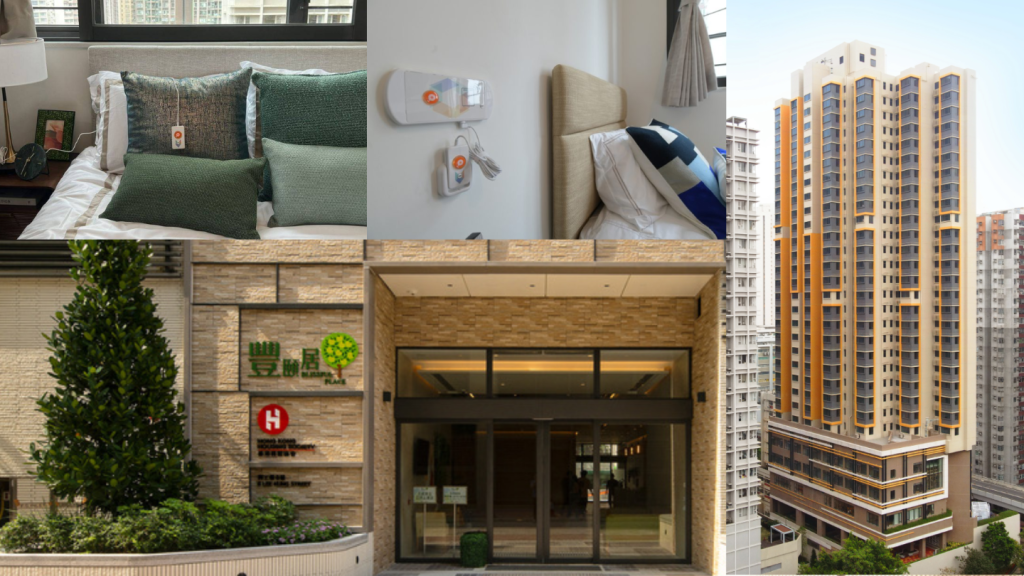
Two of HKC’s robot deployments, in the buyer’s own environment rather than a demo hall.
Blissful Place Senior Care Solution
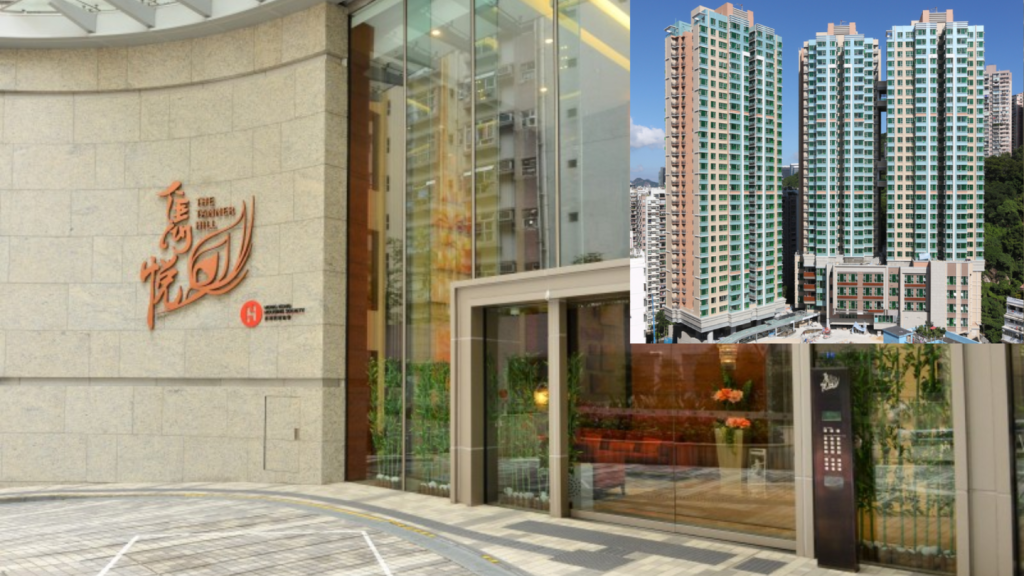
Tanner Hill Senior Care Solution
Where it is deployed
The same platform and the same products, configured to how each kind of facility actually works.
Hospitals
Ward nurse call, bedhead and door signage driven from the EHR, and asset tracking for mobile equipment.
Residential care
Panic wristbands and location tracking for residents who move freely around the building and grounds.
Rehabilitation
Activity and engagement technology alongside monitoring, for longer stays and recovery programmes.
Nursing homes
Call units, bed exit sensors, washroom fall detection and wander prevention across every floor.
Clinics & day care
Vital sign capture at the point of care, syncing to a cloud record clinicians can review later.
Frequently asked questions
Smart healthcare is a hospital, nursing home or care facility where calls for help, falls, vital signs and patient location are detected and recorded automatically rather than relying on staff noticing. Nurse call units, bed and seat sensors, panic wristbands, washroom motion sensors, health monitors and Bluetooth location tags all report into one cloud monitoring platform that shows what happened, where, and how long it took to respond.
A resident presses a call button, pulls a washroom cord or presses a panic wristband. The unit sends an alert to the central control office, where it appears in the alarm list with the resident’s name, location, device and elapsed time, and is plotted on the floor plan. Staff can acknowledge the call or open an intercom to the room. Every action is timestamped, which produces the response-time record automatically.
A motion sensor in the toilet compartment watches for movement rather than images. If it detects no movement for more than 10 minutes — adjustable in the system — it raises an abnormal alarm to management staff so an ambulance can be called immediately. It is battery powered, easy to install, and can be connected to a siren, a mobile app, a door contact sensor or a LoRaWAN network. Because it senses motion, not video, it preserves dignity in a private space.
Yes. The Bluetooth indoor positioning system places every tagged resident on the floor plan in real time, so staff have full visibility of high-risk residents and can act before someone leaves an area they should not. The same tag carries an emergency button, so a resident who needs help can raise an alarm from wherever they are.
Tags broadcast an identification signal every 1–2 seconds. Gateways around the building scan those signals and publish them through an MQTT broker to a positioning server, which calculates location from RSSI signal strength and draws it on the floor plan. It is designed for room and zone level certainty indoors — which is what matters for finding someone — rather than the metre-level precision of outdoor GPS.
Blood pressure, SpO₂, ECG, temperature, blood glucose and weight. The all-in-one vital sign monitor shows these on a 7″ touchscreen at the bedside and integrates with the nurse call system, while handheld bio-data devices cover routine rounds. Readings sync to a cloud platform so clinicians can review history, and families can see changes in their relative’s condition remotely.
No. The room door signs and bedhead care signs are battery powered e-paper displays — installation is as simple as hanging a picture on the wall. The display stays readable even during a power outage, battery life is long, and because e-paper emits no light there is no light pollution in resident rooms at night.
Yes. The signage system connects to the facility’s EHR / EMR to obtain inpatient information directly and write it to the electronic bedhead and door displays without manual operation. Change the record and the signs change. HKC is a systems integrator, so the connection is configured to the clinical system you already run.
Yes, and most homes do. Nurse call is the usual starting point because it is the highest-risk gap. Bed sensors, washroom fall detection, panic wristbands, positioning, health monitoring and signage can each be added later and report into the same monitoring platform, so nothing already installed has to be replaced.
Response time is captured on every call, so the home has an evidence base rather than an impression — which calls took longest, on which floor, at which hour. That supports staffing decisions internally and gives inspectors a documented record of how the home responds. It also increases the efficiency of healthcare workers, because they are directed to the right room rather than searching.
Hong Kong, mainland China and Singapore. HKC was established in 1970 and delivers each project end to end — supply, integration with existing clinical and building systems, installation, commissioning, staff training and ongoing support.

Tell us the task, not the robot
Describe the work you want automated — what moves, how often, how far, and how many people it takes today. That is enough for HKC to say which robot fits, whether the numbers work, and what a pilot would involve.
Related Solutions
Other products and solutions that frequently sit alongside a smart healthcare deployment.
____
AI & Robotic
AI & Robotic
______
Smart Library
_______
Smart Facilities
____
Autonomous Delivery Robot
Advanced navigation, obstacle avoidance, and intelligent route planning