
Smart Library
HKC builds complete RFID smart libraries on LIBRA, its Library RFID Automation System — self-service borrowing, automated returns and sorting, robotic stock take, 24-hour dispensers and lockers, security gates, book sterilisation and AR reading zones. Every element reads the same RFID tag and reports into one web-based platform, so a library can start with one station and grow into a fully automated service.
Made by HKC
manufacture by HKC
What is smart library?
A smart library is one where every item carries an RFID tag, so borrowing, returning, sorting, locating and auditing happen automatically — without a member of staff handling each transaction.
LIBRA integrates RFID technologies with web-based applications to produce an efficient, ideal and self-service library environment. The system benefits both users and librarians, resulting in more up-to-date inventory information, reduced labour costs, higher productivity and an enhanced level of customer service.
The practical effect is where librarian time goes. Issuing loans, discharging returns, re-shelving, shelf reading and the annual stock take are all work that machines do faster and more consistently.
What is left for staff is the part that needs a person — helping patrons, running programmes and developing the collection.
Manufacturer and systems integrator
HKC makes the library hardware and integrates it. One company is accountable for the whole system, from the plant where each unit is built to the circulation desk where it goes live.
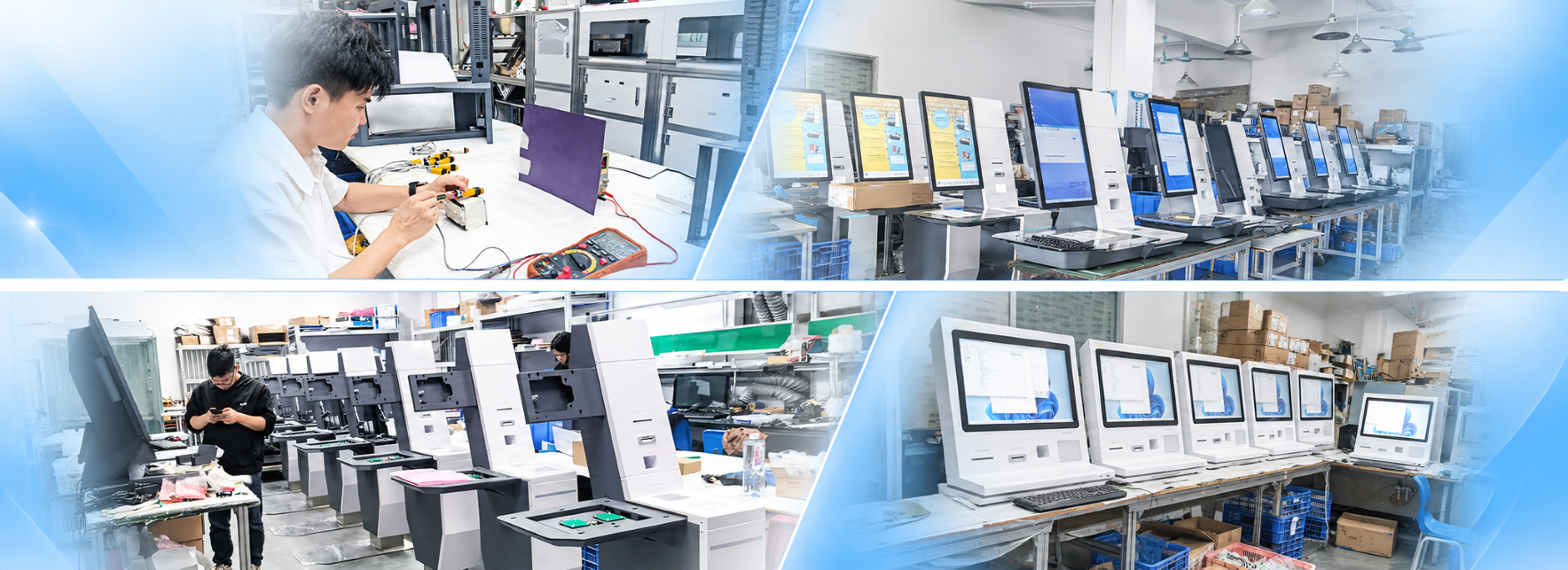
Engineered in-house
HKC designs LIBRA hardware and software together, so enclosures, RFID antennas, screens and the management platform are built to work as one system.
Built in-house
Units are assembled, wired and tested in HKC's own facility. Quality, lead times and spare parts stay under HKC's control, not a third party's.
Connected to your systems
HKC installs the hardware and connects it to your library management system, existing RFID tags, network and access control, drawing on more than 55 years in ICT.
Local Support
Local engineers in Hong Kong, mainland China and Singapore, with parts and upgrades supplied straight from the plant that built the equipment.
The whole library, connected
From the entrance gate to the 24-hour kiosk on the outside wall, every touchpoint in the building reads the same tag and writes to the same record.

The Products
Each one deploys on its own, and all of them share the same item data layer.
24 Hr Self-Service Library
Self Check In/Out Station
Integrating HF and UHF technologies, it offers a migration path that benefits both librarians and patrons.
Books Return & Sorting Unit
Customisable sorting that accurately files returned materials into pre-defined categories.
LIBRA Stock Take Robot
Swiftly scans and tracks large volumes of RFID-tagged items on shelves
Smart Bookshelf
Logistics Tracking System
It helps library staff standardize tracking items and delivery status
Front Desk Work Station
The staff-side core of an RFID library: circulation desk and tag conversion station in one.
24 Hr Books Return Unit
Swiftly scans and tracks large volumes of RFID-tagged items on shelves
Book Sterilizer
Reservation Dispenser
A 24-hour smart library service with no borrowing time limit, placed where the readers already are.
RFID Handheld Device
Administration and Monitoring System (AMS)
Self Service Information Kiosk
Automatically scrubs, mops and navigates commercial floor space
AI Vision Stock Take Robot
AI image-processing pipeline scans shelves and reads stock automatically
Express Smart Sorter
High-throughput sorting that runs around the clock behind the returns wall.
Reservation Locker
Borrow or return books and equipment at any hour, from a locker bank rather than a desk.
RFID Security Gate
Detects items leaving that were never issued, and keeps a record of what passed through.
A Star Wars pop-up library at Changi Airport, run by zero staff
An unstaffed pop-up library in Singapore Changi Airport, with RFID collection management and automated retrieval handling borrowing, returns and stock accuracy end to end.
Supply of RFID system to public library
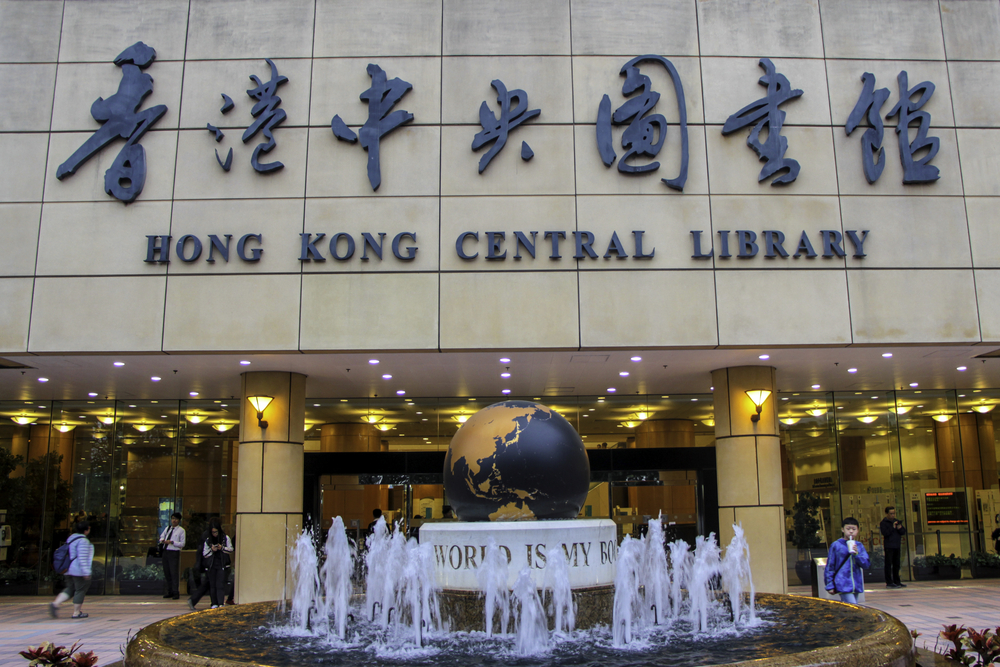
HKC was awarded a tender for the supply of RFID Intelligent Library Management System to the Hong Kong Public Libraries of the Leisure and Culture Services Department.
Frequently asked questions
An automated delivery robot is an autonomous mobile robot (AMR) that transports materials between points inside a building without a driver and without fixed guide paths. It receives a destination, plans its own route, avoids people and obstacles along the way, and hands off its load on arrival.
An AGV follows a fixed guide path such as magnetic tape, a buried wire or a painted line, and cannot leave it. An AMR builds and localises against a map of the building itself, so it can plan a new route around an unexpected obstacle. The practical consequence: an AGV stops when a pallet blocks its line; an AMR drives around it.
The robots has a rated load of 300 kg – 1500kg and carries standard three-runner pallets on integrated forks.
The robot (P300 series) needs a minimum passage width of 580 mm and turns within a 988 mm circle. Another robot (P1500 series) needs 990 mm to travel, turns within 1,680 mm, and needs 1,800 mm to pick and place a pallet at a right angle. These are unusually tight for a 1.5-tonne pallet vehicle and are the reason most sites can deploy without widening aisles.
It stops within ±10 mm of the target position and within ±0.5° of the target heading. That is close enough for automatic transfer to a conveyor, a fixed station or a rack without a person aligning the load.
No. Robot uses laser SLAM free navigation, mapping and localising against the building’s existing walls, racking and structure. Nothing is installed in or on the floor before deployment. Reflector-based navigation is available as an additional feature where a site’s geometry makes it useful, but it is not a requirement.
About 10 minutes from unboxing to running the first delivery task. That figure is measured on a single unit in a standard scenario of roughly 200 m² — a larger or more complex site takes longer to map and tune. No production line changes and no on-site server are required.
The P300 series runs a 48 V / 20 Ah lithium iron phosphate pack, giving about 8 hours unloaded. It charges from 10% to 80% in under an hour and docks itself automatically when idle, so it sustains 7 × 24 operation without being taken out of service. Cycle life is rated at 1,500 cycles or more.
The P1500 series uses hot-swappable batteries instead: a pack is exchanged in about 30 seconds with no power interruption and no connector to unplug by hand, which suits continuous multi-shift operation.
Yes — both are designed for mixed human and robot traffic. Sensing is layered rather than singular: a head-mounted 3D lidar scanning 360° horizontally with a tall vertical field, an obstacle camera for dynamic object tracking and foot protection, and two 2D safety lidars on the chassis front and rear. A physical emergency stop cuts drive power independently of the software. Ambient lighting, turn indicators and a voice system signal the robot’s intent to people nearby.
Yes. IoT integration covers elevators, doors, gates and access control, so a route can cross floors or controlled boundaries unattended. This is what makes multi-floor and retrofitted buildings viable without a person escorting the robot.
Yes. The robots expose an open API for task dispatch and status reporting, so an existing system can issue deliveries directly. Tasks can also be created from the robot’s own screen, from a phone, or from call terminals placed at pick-up points — useful where floor staff are not at a computer.
It paybacks from 6 months in favourable cases, driven by minimal deployment cost and 7 × 24 running. The honest answer is that ROI depends entirely on your shift pattern, transport distance, move frequency and local labour cost. Treat 6 months as a best case and model it against your own volumes before committing.
The P300 accepts several standard top modules — roller conveyor, cabinet, shelf, pallet and bin frame — and an optional jacking platform (680 × 460 mm) that lifts a rack or trolley 60 mm in about three seconds. The P1500 is a dedicated pallet handler with integrated forks.
Yes, and that is the usual path. A single robot on one route proves the case; the same hardware and software carry forward as more are added. The P1500 is explicitly field-upgradable to full AGV fleet operation, so a pilot does not have to be replaced to become a fleet.
Both are made by SEER Robotics (Shanghai Seer Intelligent Technology), founded in 2020 and headquartered in Shanghai, with subsidiaries in Hong Kong, Germany, Wuxi, Shenzhen and Chengdu. The founding team came out of Zhejiang University and won the RoboCup robot football world championship three times. Investors include GLP Hidden Hill Capital, China Growth Capital, Ecovacs, IDG and SAIF Partners.
Tell us the task, not the robot
Describe the work you want automated — what moves, how often, how far, and how many people it takes today. That is enough for HKC to say which robot fits, whether the numbers work, and what a pilot would involve.

contact_hkcgroup@hkc.net

Call Us
+852 2527 8822

Office Address
14/F., Block B, Vita Tower, 29 Wong Chuk Hang Road, Hong Kong